The Stage, the Captions, the Aisle: An Inclusion Post-Mortem on ICFHR 2022's Event Design
Photo: William Murphy, CC BY-SA 3.0, via Wikimedia Commons
Every conference promises to be inclusive. Few are audited on it. As the organizing body behind ICFHR 2022, we believe the honest move is to review our own event design the way we would review a submitted research paper: against stated claims, with the flaws left in.
What follows is not a press release. It is a post-mortem of the physical and cognitive accessibility choices we made in 2022 — the ones that worked, the ones that fell short — translated into guidance for American HR teams planning everything from regional trainings to the annual all-hands.
What the Room Said Before Anyone Spoke
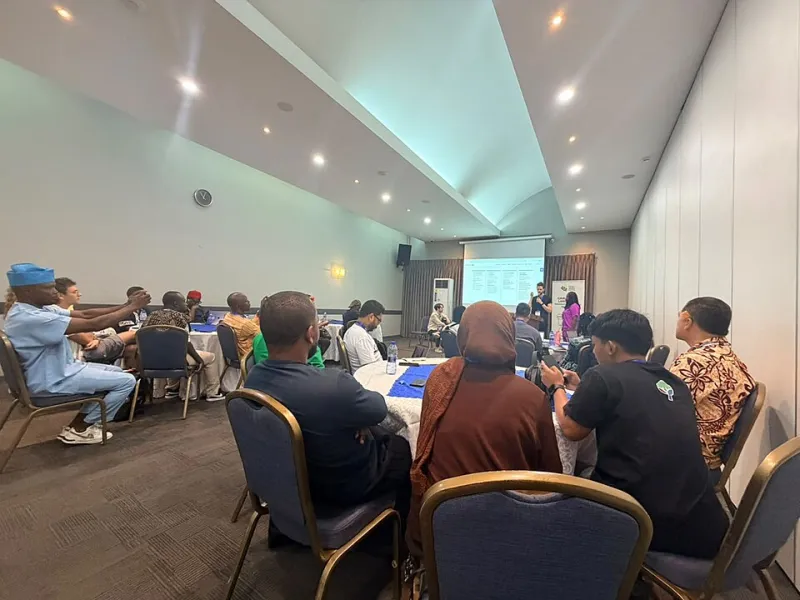
The main hall at ICFHR 2022 followed the standard international-conference template: banked seating, a raised stage, and a center aisle wide enough for mobility devices. On paper, we met baseline requirements. In practice, three failures emerged that US event planners will recognize immediately.
First, accessible seating was clustered at the back of sections, which is compliant but not equivalent — late-arriving attendees using wheelchairs had sightlines partially blocked by standing participants. Second, the quiet room we designated for attendees sensitive to sensory overload was placed beside the exhibitor lounge, where vendor demos ran audio on a loop. Third, step-free access to the poster session required a detour through a service corridor that two attendees reported finding only after asking staff.
None of these were malicious. All of them were predictable. That is the core lesson: accessibility failures are rarely exotic. They are the predictable output of rooms designed by people who will never experience them as a disabled attendee.
Captioning: The Metric That Exposed Us
We contracted live captioning for all plenary sessions, and the captions were, by most measures, good — roughly 96% accuracy on clean audio, according to our vendor's post-event report. The remaining 4% is where the story lives.
Technical terminology took the heaviest damage. "Algorithmic fairness" appeared as "algorhythmic for us." Speaker names fared worse. And because captions streamed to a single shared screen at the front of the room rather than to personal devices, attendees who needed them had to choose between watching the speaker and reading the text.
For US employers, the parallel is direct. Your town halls, your benefits enrollments, your compliance trainings — if captions exist only as a projected afterthought, you have built a service that works until it matters. The fix we adopted for later sessions: individual device streaming, a pre-shared glossary of technical terms, and a designated staff member whose sole job during sessions was monitoring caption quality in real time.
Pacing Is an Accessibility Issue
The least visible accessibility failure at ICFHR 2022 involved neither ramps nor screens. It was the schedule itself.
Our sessions ran 90 minutes with 15-minute transitions — a cadence calibrated for healthy, neurotypical, jet-lag-free attendees, which described almost nobody in attendance. Deaf attendees relying on interpreters fatigue faster without breaks. Attendees with chronic pain conditions reported that back-to-back blocks forced them to skip afternoon content entirely. Parents juggling sessions across time zones had no built-in processing time at all.
We ran a pulse survey mid-conference, and the results reshaped our final day on the fly: sessions trimmed to 75 minutes, transitions extended, and one full block converted to unstructured time. Attendance in the final afternoon rose. So did session ratings. Cognitive load, we learned, is a design variable, not a personal failing of your audience.
A Checklist for Your Next All-Hands
US HR leaders can adapt what we learned — and what we got wrong — using this audit framework:
- Walk the route. Have someone physically navigate the full attendee journey — parking, entry, restrooms, stage, exits — using a mobility device before you book the venue, not after.
- Decentralize captions. Stream to personal devices; never rely on one distant screen. Test with your actual presenters and your actual jargon.
- Zone the room. Accessible seating distributed throughout, not warehoused in one corner. Quiet space located away from audio sources, verified on-site.
- Budget the calendar. Shorter sessions, longer transitions, and protected breaks scheduled as deliberately as keynotes.
- Name an owner. Accessibility that belongs to everyone belongs to no one. Assign a staff member with authority to fix problems mid-event.
- Survey in real time. A mid-event pulse check catches failures while they can still be corrected — and signals that inclusion is operational, not decorative.
The Findings We Would Submit Today
If ICFHR 2022 were a research paper, the peer reviewers would note that our accessibility claims were directionally sincere but operationally under-tested. We published a program; we did not pilot a room.
American employers preparing for return-to-office gatherings, hybrid town halls, and large-scale trainings have an advantage we lacked: you can rehearse. Run your accessibility audit as a dress rehearsal with disabled employees in the room and the authority to change the plan. The ROI is not abstract — it is the difference between an event your entire workforce can attend and one that quietly excludes the people your inclusion statements say you value.
The audit nobody filed in 2022 is the one we are filing now. Consider it yours to reuse.