From Poster Board to Offer Letter: What Three Early-Career Scholars Learned Selling Their Research in Person
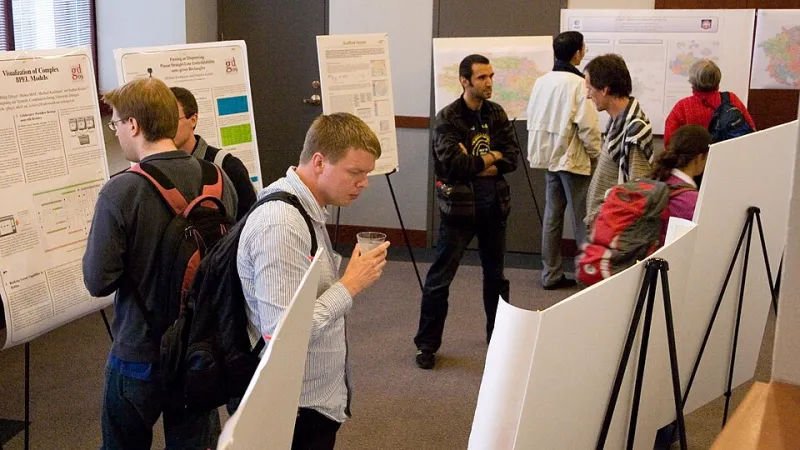
Photo: David Eppstein, CC BY-SA 3.0, via Wikimedia Commons
For decades, the assumption in academic HR circles has been that the keynote stage is where careers are made. The reality, judging by what happened after ICFHR 2022, is considerably less glamorous: the poster hall — with its foam boards, lukewarm coffee, and fifteen-minute attention spans — quietly produced more job offers, consulting engagements, and industry partnerships than any plenary session.
Consider three early-career researchers whose paths crossed with hiring decision-makers during the poster sessions. Within nine months of the conference, one had accepted a tenure-track appointment at a midwestern public university, another had signed a research consulting contract with a Fortune 500 retailer, and a third had established a multi-year partnership between her lab and a regional health system. None of them delivered a keynote. All of them treated their poster presentation as a professional pitch rather than a formality.
What the Hiring Side Actually Remembers
We spoke with two deans and a chief human resources officer who attended ICFHR 2022 specifically to scout emerging talent. Their observations converge on a few points that graduate students rarely hear stated plainly.
First, clarity beats complexity. The dean of a large US business school described skimming more than sixty posters in ninety minutes. What stopped her, she said, was not methodological sophistication but a headline finding she could restate in one sentence. "If I can't explain your research to my provost by the time I reach the parking garage, it didn't happen."
Second, the conversation matters more than the board. The CHRO we interviewed, who later hired one of the three scholars as a consultant, recalled almost nothing about the poster's visual design. What she remembered was the presenter's response to a skeptical question about sample size — candid, non-defensive, and grounded. "That's the interview," she said. "Everything else is theater."
Third, availability signals seriousness. Presenters who stood beside their work for the full session, rather than drifting away, were consistently the ones who received follow-up emails. Hiring committees read presence as commitment.
Three Careers, Three Very Different Outcomes
The tenure-track hire attributed her success to preparation she almost skipped: a one-page handout with her contact information, a QR code linking to her dissertation, and three bullet points summarizing practical implications. A department chair took the handout, forwarded it to a colleague at another institution, and the interview invitation followed within six weeks.
The consultant's breakthrough came from reframing his research question in business language. Where his abstract discussed "turnover intention antecedents," his verbal pitch described "why your best people quietly start job hunting eighteen months before they leave." He estimates that translation — from academic vocabulary to executive vocabulary — was worth the entire contract.
The partnership builder succeeded by doing something almost no one does: she followed up. Every business card she collected received a personalized email within seventy-two hours, referencing something specific from the conversation. Half the recipients never replied. One did, and that reply became a health system's decision to fund a two-year study on clinical staff retention.
Practical Guidance for Your Next Poster
If you are a graduate student planning for a future conference, the lessons from ICFHR 2022 can be reduced to a short checklist.
- Lead with the finding, not the literature review. Your poster title should state a result or a provocative question.
- Prepare a thirty-second version, a two-minute version, and a ten-minute version of your pitch — and know when to deploy each.
- Bring something physical to hand over. Paper survives the walk to the parking garage; a bookmarked website does not.
- Translate your jargon. Practice explaining your work to a friend outside academia until they can repeat it back accurately.
- Stay at your board. Then follow up within three days, while the memory is still fresh.
The elevator pitch has long been the shorthand for career-making brevity. At modern academic conferences, the poster session has inherited that role — with one advantage the elevator never offered: you get fifteen minutes, an audience that chose to stop, and a wall behind you covered in evidence. Use all three.